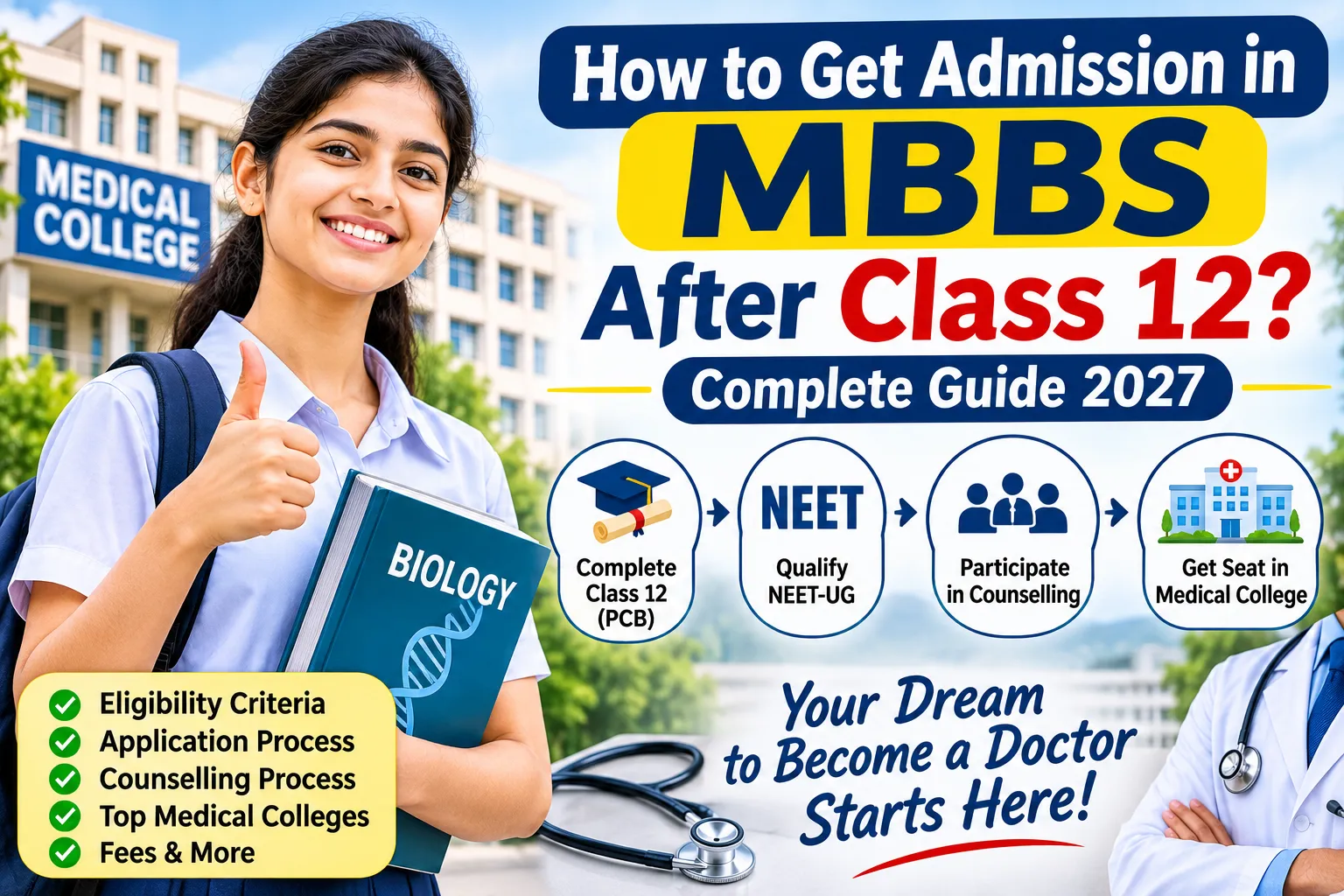
How to Get Admission in MBBS After Class 12?
Becoming a doctor is one of the most popular career aspirations among students in India. Every year, thousands of students complete their Class 12 examinations with the dream of pursuing a Bachelor of Medicine and Bachelor of Surgery (MBBS).
However, getting admission to an MBBS programme requires more than just passing Class 12. Students must fulfil the prescribed eligibility criteria, qualify for the National Eligibility cum Entrance Test (NEET-UG), participate in the counselling process and secure a seat in a recognised medical college.
If you have completed Class 12 or are appearing for your board examinations and want to become a doctor, this guide will help you understand how to get admission in MBBS after Class 12 in India.
Let's explore the complete MBBS admission process step by step.
1. Complete Class 12 with Physics, Chemistry and Biology
The first step towards becoming a doctor is choosing the Science stream with Biology in Class 11 and Class 12.
Students generally need to study the following subjects:
- Physics
- Chemistry
- Biology (Botany and Zoology)
- English
These subjects provide the academic foundation required for medical education.
Students must pass the qualifying examination and fulfil the prescribed subject-wise and aggregate marks requirements.
Minimum Marks Required in Class 12 for MBBS
The general qualifying requirements are:
| Category | Minimum PCB Aggregate |
| General / EWS | 50% |
| General-PwBD | 45% |
| SC / ST / OBC-NCL | 40% |
These are the general minimum eligibility requirements. Students should check the latest NEET information bulletin and applicable medical education regulations for specific conditions.
Important: Students appearing for their Class 12 board examinations can also apply for NEET provisionally, subject to fulfilling the eligibility requirements before admission.
2. Check the Age Eligibility for MBBS Admission
Students must satisfy the minimum age requirement prescribed for MBBS admission.
Under the existing eligibility framework, candidates must have completed 17 years of age by the applicable admission-year deadline.
For the 2027 admission session, students should verify the exact age calculation and cutoff date in the official NEET-UG 2027 information bulletin.
There is currently no upper age limit for appearing in NEET-UG.
3. Qualify NEET-UG Examination
The National Eligibility cum Entrance Test (NEET-UG) is the mandatory entrance examination for MBBS admission in India.
It is conducted by the National Testing Agency (NTA).
Students seeking admission to the following institutions must qualify NEET-UG:
- Government medical colleges
- Private medical colleges
- Deemed universities
- AIIMS institutions
- JIPMER
- Central government medical institutions
There is no separate MBBS entrance examination for AIIMS or JIPMER. Admission is based on NEET-UG performance and the applicable counselling process.
NEET-UG Examination Pattern
For NEET-UG 2027, the published examination information specifies the following pattern:
| Particulars | Details |
| Examination Name | NEET-UG 2027 |
| Conducting Authority | National Testing Agency |
| Examination Mode | Offline (Pen and Paper) |
| Total Questions | 200 |
| Questions to be Attempted | 180 |
| Maximum Marks | 720 |
| Examination Duration | 3 Hours 20 Minutes |
| Subjects | Physics, Chemistry and Biology |
| Correct Answer | +4 Marks |
| Incorrect Answer | -1 Mark |
| Unanswered Question | 0 Marks |
Subject-wise Distribution
| SubjectQuestions to AttemptMaximum Marks | ||
| Physics | 45 | 180 |
| Chemistry | 45 | 180 |
| Biology | 90 | 360 |
| Total | 180 | 720 |
Students should prepare all three subjects thoroughly because each plays an important role in determining their NEET score and All India Rank.
4. Register for NEET-UG Examination
After checking the eligibility requirements, students need to complete the online NEET application process.
The general application procedure includes:
Step 1: Visit the Official Website
Visit the official NEET website:
Step 2: Complete Online Registration
Register using your name, mobile number, email address and other required personal information.
Step 3: Fill Out the Application Form
Enter your personal details, educational qualifications, category and examination city preferences.
Step 4: Upload Required Documents
Upload your photograph, signature and other documents according to the prescribed specifications.
Step 5: Pay the Application Fee
Pay the applicable examination fee using the available online payment methods.
Step 6: Download the Confirmation Page
After successful submission, download and save the application confirmation page.
Students should carefully verify all details before submitting the application form.
5. Prepare for NEET-UG Examination
Preparing for NEET requires consistency, proper planning and regular practice.
Students should ideally begin preparation during Class 11 rather than waiting until their Class 12 examinations are completed.
Here are some useful preparation strategies:
Focus on NCERT Books
NCERT textbooks for Classes 11 and 12 are important study resources for NEET preparation, particularly for Biology and Chemistry.
Prepare a Daily Study Schedule
Allocate sufficient time to Physics, Chemistry and Biology. Give additional attention to subjects and topics where you need improvement.
Solve Previous Years' Question Papers
Practising previous NEET question papers helps students understand the examination pattern and identify frequently tested concepts.
Take Regular Mock Tests
Mock tests help students improve accuracy, manage examination time and identify weak areas.
Revise Important Topics
Regular revision of formulas, diagrams, chemical reactions and biological concepts can improve retention and examination performance.
Avoid Unnecessary Study Materials
Use reliable textbooks and study resources rather than collecting too many books and notes.
6. Check Your NEET Result and All India Rank
After conducting NEET-UG, NTA declares the examination results.
Students can download their scorecards through the official NEET website.
The result generally includes:
- Candidate's name and roll number
- Total marks obtained
- Percentile score
- All India Rank (AIR)
- Category rank, where applicable
- Qualifying status
Your NEET score and rank are important for determining the medical colleges available to you during counselling.
Remember: Qualifying NEET does not automatically guarantee an MBBS seat. Actual admission depends on your rank, category, seat availability, college preferences and applicable counselling rules.
7. Participate in MBBS Counselling
After the declaration of NEET results, eligible candidates must participate in the authorised counselling process.
The counselling process allows students to select their preferred medical colleges and compete for available MBBS seats.
There are two major counselling channels in India.
A. All India Quota (AIQ) Counselling
The Medical Counselling Committee (MCC) conducts counselling for the applicable All India Quota seats and participating institutions.
MCC counselling generally covers:
- 15% All India Quota seats in government medical colleges
- AIIMS institutions
- JIPMER institutions
- Deemed universities
- Central universities
- Other participating institutions and seat categories
Official Website: https://mcc.nic.in/
B. State Quota Counselling
State counselling authorities conduct counselling for state quota seats and other medical seats assigned to them.
Generally, 85% of government medical college seats are covered under state quota, subject to applicable exceptions.
Students may need to fulfil additional requirements such as:
- State domicile
- Educational qualifications
- Category and reservation requirements
- State-specific eligibility conditions
For example, students seeking MBBS admission in Jharkhand should check the counselling notifications issued by the Jharkhand Combined Entrance Competitive Examination Board (JCECEB).
Official Website: https://jceceb.jharkhand.gov.in/
8. Complete the MBBS Choice Filling Process
Choice filling is one of the most important stages of medical admission.
During this process, students select their preferred medical colleges and arrange them according to their priorities.
For example, a student may choose:
- AIIMS New Delhi
- AIIMS Bhopal
- AIIMS Bhubaneswar
- RIMS Ranchi
- MGM Medical College, Jamshedpur
- Other preferred government medical colleges
- Eligible private medical colleges
The actual choices should be based on the student's NEET rank, eligibility, budget and college preferences.
Tips for College Choice Filling
- Research the college before adding it to your preference list.
- Check the available MBBS seats.
- Compare tuition fees and hostel charges.
- Review previous years' closing ranks.
- Consider the location and distance from home.
- Check the teaching hospital and clinical facilities.
- Arrange colleges according to your actual preference.
Do not select a college only because it is popular. Consider the complete educational environment and affordability.
9. Check the MBBS Seat Allotment Result
After choice filling and locking, the counselling authority processes the preferences according to merit, reservation policies, seat availability and applicable rules.
If a seat is allotted, students can download their seat allotment letter.
The allotment letter contains important information such as:
- Candidate details
- Allotted medical college
- Course name
- Seat category
- Reporting instructions
- Admission deadlines
Students must carefully read the reporting instructions and complete the admission formalities within the specified time.
10. Visit the Medical College and Complete Admission
After receiving the seat allotment letter, candidates must report to the allotted medical college for document verification and admission.
The commonly required documents include:
- NEET-UG Admit Card
- NEET-UG Scorecard
- Class 10 Marksheet and Certificate
- Class 12 Marksheet and Certificate
- Transfer Certificate
- Migration Certificate, if applicable
- Date of Birth Proof
- Identity Proof
- Passport-size Photographs
- Category Certificate, if applicable
- EWS Certificate, if applicable
- PwBD Certificate, if applicable
- Domicile Certificate, where required
- Counselling Registration Details
- Seat Allotment Letter
- Other documents required by the college
Candidates should carry original documents and the required number of photocopies.
After successful verification, students must pay the prescribed admission fees and complete the remaining institutional formalities.
11. Understand the MBBS Course Duration and Fees
The MBBS programme generally takes 5.5 years to complete.
It includes:
- 4.5 years of academic medical education
- 1 year of compulsory rotating medical internship
During this period, students receive theoretical education, practical laboratory training and clinical exposure in affiliated teaching hospitals.
Approximate MBBS Fees in India
The cost of MBBS education depends on the institution and its fee regulations.
| Type of Medical College | Indicative Annual Tuition Fees |
| Government Medical College | ?10,000 – ?1,50,000 |
| Private Medical College | ?15 lakh – ?45 lakh |
| Deemed University | ?25 lakh – ?65 lakh or more |
These figures are indicative planning ranges, not official 2027 fee notifications. Actual fees may differ significantly.
Students should also consider hostel charges, mess fees, security deposits, examination fees and other institutional expenses.
12. Types of Medical Colleges You Can Choose After Class 12
Students can explore different categories of medical institutions after qualifying NEET.
Government Medical Colleges
Government medical colleges generally offer comparatively affordable MBBS education.
Examples include:
- AIIMS New Delhi
- Maulana Azad Medical College, Delhi
- King George's Medical University, Lucknow
- RIMS Ranchi
- MGM Medical College, Jamshedpur
Private Medical Colleges
Private medical colleges offer MBBS programmes through the applicable NEET-based counselling process.
Students should compare fees, infrastructure, teaching hospital facilities and academic quality before choosing a college.
Deemed Universities
Deemed-to-be universities also offer MBBS programmes through NEET-based admission and the applicable counselling process.
Examples include:
- Kasturba Medical College, Manipal
- JSS Medical College, Mysuru
- Sri Ramachandra Medical College, Chennai
- Bharati Vidyapeeth Medical College, Pune
AIIMS Institutions
AIIMS institutions are among India's well-known medical institutions.
Students can apply for MBBS admission through NEET-UG and the applicable MCC counselling process.
13. Can You Get MBBS Admission Without NEET?
No. NEET-UG qualification is mandatory for MBBS admission in India under the applicable national admission framework.
Students cannot secure a valid MBBS seat through direct admission, donation or management quota without fulfilling NEET qualification requirements.
This applies to government medical colleges, private medical colleges, deemed universities and AIIMS institutions.
Be careful of agents or institutions promising guaranteed MBBS admission without NEET.
Always verify admission details through official counselling authorities.
14. What Should You Do If You Do Not Get an MBBS Seat?
Not every student secures an MBBS seat in their first attempt.
If you do not receive a seat, you can consider the following options:
Prepare for NEET Again
If becoming a doctor is your primary goal, you can consider taking another attempt after reviewing your previous performance and improving your preparation strategy.
Explore Other Medical and Healthcare Courses
Students interested in healthcare can also explore alternative undergraduate courses, depending on their eligibility and career interests.
Some options include:
| Course | Full Form |
| BDS | Bachelor of Dental Surgery |
| BAMS | Bachelor of Ayurvedic Medicine and Surgery |
| BHMS | Bachelor of Homeopathic Medicine and Surgery |
| BPT | Bachelor of Physiotherapy |
| B.Sc Nursing | Bachelor of Science in Nursing |
| B.Pharm | Bachelor of Pharmacy |
| BOT | Bachelor of Occupational Therapy |
| BMLT | Bachelor of Medical Laboratory Technology |
| B.Sc Radiology | Bachelor of Science in Radiology and Imaging Technology |
Admission requirements differ between courses. Some require NEET, while others have separate admission procedures.
Students should check the eligibility and admission requirements of each course before applying.
15. Important Tips for Students Seeking MBBS Admission After Class 12
Here are some practical suggestions for students and parents:
- Choose Physics, Chemistry and Biology in Class 11.
- Start NEET preparation early.
- Focus on NCERT textbooks.
- Keep track of NEET application notifications.
- Practise mock tests regularly.
- Maintain good academic performance in Class 12.
- Research medical colleges before counselling.
- Compare government and private college fees.
- Prepare all admission documents in advance.
- Participate in the correct counselling process.
- Follow official counselling deadlines.
- Avoid unauthorised admission agents.
A well-planned approach can make the admission journey easier and help students avoid common mistakes.
Frequently Asked Questions (FAQs)
1. Can I get MBBS admission directly after Class 12?
Students can pursue MBBS after completing Class 12 with the required subjects. However, they must qualify NEET-UG and secure a seat through the authorised counselling process.
2. Is NEET compulsory for MBBS admission in India?
Yes. NEET-UG is mandatory for MBBS admission in government medical colleges, private medical colleges, deemed universities, AIIMS and JIPMER.
3. Can I apply for NEET while appearing for Class 12?
Yes. Students appearing for their Class 12 examinations can generally apply provisionally, subject to fulfilling the prescribed eligibility requirements before admission.
4. What percentage is required in Class 12 for MBBS?
The general minimum PCB aggregate requirements are 50% for General/EWS, 45% for General-PwBD and 40% for SC/ST/OBC-NCL candidates, subject to applicable regulations.
5. How many marks are required in NEET for MBBS admission?
There is no fixed NEET score that guarantees an MBBS seat. The required marks depend on the college, category, competition, state, counselling round and seat availability.
6. Can I get admission to a government medical college after Class 12?
Yes. Students who qualify NEET-UG can participate in All India Quota and eligible state counselling processes to compete for government medical college seats.
7. Can I get MBBS admission in a private college with a low NEET score?
It may be possible depending on your NEET qualification status, rank, category, available seats, college preferences and applicable counselling rules. Admission without qualifying NEET is not permitted.
8. How long does it take to complete MBBS in India?
The MBBS programme generally takes 5.5 years, including 4.5 years of academic education and one year of compulsory rotating medical internship.
9. Can students from other states apply for MBBS admission?
Yes. Students can participate in applicable All India Quota counselling and other eligible admission categories. State quota eligibility depends on the respective state's rules.
10. Which is better: Government or Private Medical College?
Government medical colleges generally offer lower tuition fees, while private colleges may provide additional options for students depending on their NEET rank and budget. Students should compare recognition, faculty, clinical exposure, infrastructure and overall fees before deciding.
Conclusion
Getting admission to an MBBS programme after Class 12 requires academic preparation, qualifying NEET-UG and successfully completing the medical counselling process.
Students should begin their preparation early, understand the eligibility criteria, research medical colleges and keep track of official admission notifications.
Choosing the right medical college is equally important. Consider the institution's academic environment, hospital facilities, clinical training, fee structure and future career opportunities before making your final decision.
At AdmissionAdvisorIndia.com, we aim to help students and parents explore medical colleges, understand admission procedures and make informed decisions about their educational future.
Start exploring medical colleges and take the first step towards achieving your dream of becoming a doctor!
Need help understanding your options?
Send an enquiry and tell us which course you are considering.
Request Guidance