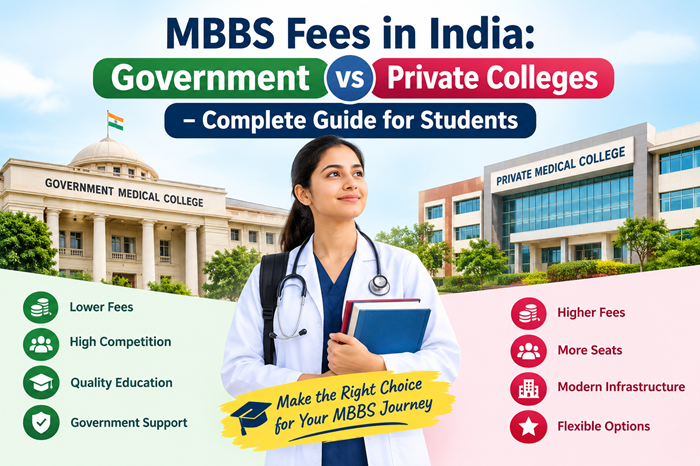
MBBS Fees in India: Government vs Private Colleges – Complete Guide for Students
Pursuing an MBBS degree is a dream for many students who want to build a career in medicine. However, before taking admission, students and parents need to understand the total cost of medical education. One of the most important decisions is choosing between a government medical college and a private medical college.
MBBS fees in India vary considerably depending on the state, institution, seat category, and facilities offered. Government medical colleges generally have lower tuition fees, while private medical colleges may charge significantly higher amounts. Students must also consider hostel fees, examination charges, food, books, and other expenses.
In this article, we explain the difference between government and private MBBS college fees in India, estimated expenses, factors affecting tuition fees, and how students can choose a medical college according to their budget.
1. What Are the MBBS Fees in India?
The cost of studying MBBS in India depends primarily on the type of medical college and the seat allotted to the candidate through the applicable counselling process.
Government medical colleges usually receive public funding, which allows them to offer medical education at comparatively lower tuition fees. Private medical colleges generally charge higher fees, although the amount can differ significantly between institutions and seat categories.
The following table provides broad, indicative planning ranges. These are not official national fee limits or guaranteed fees for any particular college.
| Expense or college type | Indicative cost | |
|---|---|---|
| Government medical college tuition | ₹5,000–₹1 lakh per year | |
| Private medical college tuition | ₹5 lakh–₹25 lakh per year | |
| Some high-fee private or deemed universities | ₹20 lakh–₹30 lakh or more per year | |
| Hostel and food expenses | Varies by college and location | |
| Books, examination and other charges | Books, examination and other charges |
| Academic year | Listed fees |
|---|---|
| First year | ₹17,900 |
| Second year | ₹13,881 |
| Third year | ₹13,881 |
| Fourth year | ₹13,881 |
| Fifth year | ₹13,881 |
The published schedule notes additional hostel fees of ₹6,000 for the first year and includes hostel fees in the listed charges for subsequent years. Students should check the official schedule for the exact inclusions and applicable admission conditions.
This example demonstrates why checking the individual college fee structure is important. Government college fees are not identical across India.
3. MBBS Fees in Private Medical Colleges
Private medical colleges provide additional MBBS admission opportunities for eligible students, but their fees can be substantially higher than those of government institutions.
The amount payable depends on the college, state fee regulations, university status, and the seat category under which admission is granted.
Factors Affecting Private Medical College Fees
- Tuition fees prescribed for the relevant seat category.
- Government quota or management quota classification, where applicable.
- Deemed university fee structure, where applicable.
- Hostel and mess charges.
- Admission, university and examination fees.
- Security deposits and other authorised charges.
- Additional expenses specified in the official fee schedule.
Example of Private College Fee Differences
The Surat Municipal Institute of Medical Education and Research publishes different fee amounts for different MBBS admission categories
Its listed annual fees for 2026–27 include:
| Seat category | Listed annual fee |
|---|---|
| Non-NRI | ₹11.23 lakh |
| Management quota | ₹24.06 lakh |
These figures are specific to the institution and its published fee schedule. They should not be treated as standard fees for all private medical colleges.
Before choosing a private college, students should obtain a complete written breakdown of the fees payable throughout the course.
4. Government vs Private MBBS Colleges: Fee Comparison
The main difference between government and private medical colleges is often the total financial commitment required from the student.
| Comparison factor | Government college | Private college |
|---|---|---|
| Tuition fees | Generally lower | Generally higher |
| Competition for seats | Often highly competitive | Varies by college and seat category |
| Hostel expenses | Depends on the institution | Depends on the institution |
| Admission process | Applicable NEET counselling | Applicable NEET counselling |
| Fee structure | Institution and state dependent | Institution, state and seat-category dependent |
| Financial planning | Often more affordable | May require a larger budget |
Neither the government nor the private label alone determines the quality of education. Students should also evaluate teaching facilities, clinical exposure, recognition status, hospital infrastructure, and the overall learning environment.
5. What Is the Total Cost of Completing MBBS in India?
Students should not calculate their medical education budget using tuition fees alone. The total cost includes other expenses that can accumulate over the course.
The MBBS academic course generally comprises four and a half years of academic study followed by a compulsory rotating medical internship, subject to applicable regulations.
Consider these expense categories when preparing your budget.
Tuition Fees
Tuition fees are usually the largest component of the overall cost. Multiply the applicable annual fee by the relevant academic years, while checking whether the fee can change during the course.
Hostel and Mess Fees
Students studying away from home may need to pay for accommodation and meals. The amount depends on the city, hostel facilities, room type, and mess arrangements.
Books and Study Materials
Medical students may need textbooks, reference materials, instruments, stationery, and other academic resources.
Examination and University Charges
Some colleges charge additional amounts for examinations, university registration, laboratory facilities, or other authorised academic services.
Travel and Personal Expenses
Transport, clothing, communication, personal supplies, and travel home during holidays should also be included in the budget.
Tip: Ask the college for the complete course fee schedule, including recurring charges, one-time deposits, hostel expenses, refund conditions, and any approved fee revisions.
6. Can Students Get MBBS Admission at a Lower Cost?
Yes, students can explore several options to manage the cost of medical education. The most suitable option depends on their NEET rank, eligibility, financial circumstances, and the available seats.
Apply for Government Medical College Seats
Government medical colleges can be a more affordable option for eligible candidates. Students should review their NEET rank, category, state eligibility, and previous counselling results to identify realistic choices.
Explore State Quota Seats
State counselling may provide access to applicable state quota seats in government colleges and other participating institutions. Eligibility, domicile rules, seat availability, and fee structures vary by state.
Compare Government Quota Seats in Private Colleges
Some states provide government quota seats in private medical colleges at fees prescribed under the relevant rules. Students should check the current official seat matrix and fee schedule.
Check Scholarships and Financial Assistance
Eligible students may be able to apply for government scholarships, category-based schemes, or other educational assistance. Availability depends on the scheme's eligibility criteria and the student's circumstances.
Plan Your Budget Before Counselling
Prepare a realistic budget that includes tuition, hostel, food, travel, and other charges. This helps you avoid selecting a college whose total cost is beyond your family's financial capacity.
7. Is an Education Loan Available for MBBS?
Students who need financial assistance can explore education loans from banks and eligible financial institutions.
Before applying, compare the interest rate, processing charges, repayment period, moratorium conditions, collateral requirements, and any applicable government interest-support schemes.
Lenders may assess the student's admission offer, institution, course fees, co-applicant details, and repayment capacity.
Do not assume that every loan covers all expenses. Confirm whether tuition, hostel, books, travel, and other costs are eligible under the specific loan terms.
8. How to Choose the Right Medical College According to Your Budget
Selecting a medical college is an important decision that can affect your finances and educational experience.
Before confirming admission, consider these factors:
- Recognition status: Verify the college and its MBBS course through the official National Medical Commission resources.
- Total course cost: Calculate tuition and additional expenses for the entire course.
- Clinical exposure: Review the attached teaching hospital, patient exposure, and available facilities.
- Location: Consider accommodation, transportation, safety, and living expenses.
- Counselling eligibility: Confirm the applicable admission process and seat category.
- Fee transparency: Request an official written fee schedule.
- Refund policy: Understand the rules for withdrawal, resignation, and security deposits.
- Financial sustainability: Choose an institution whose fees your family can reasonably manage.
Never pay unofficial charges based on verbal promises of a guaranteed medical seat. Follow the official counselling procedure and retain receipts for all authorised payments.
9. How to Check the Official MBBS Fee Structure
Fee details may change between admission sessions. Students should verify the fees for the exact academic year in which they plan to take admission.
Use these official resources:
- Medical Counselling Committee (MCC): https://mcc.nic.in/ — for applicable All India Quota and other designated counselling processes, including official counselling information.
- National Medical Commission (NMC): https://www.nmc.org.in/ — to check medical college and course information.
- State counselling authority: Consult the official website for your state to review state quota seats, fee notices, and counselling instructions.
- College website: Look for the latest prospectus, official fee circular, and detailed admission instructions.
For private medical institutions and deemed universities, NMC has issued guidance concerning fee determination for specified seats. The actual applicable fee still needs to be checked against the relevant institution's official schedule and current rules.
10. Common Mistakes to Avoid While Comparing MBBS Fees
Students and parents should avoid these common mistakes:
- Comparing only tuition fees instead of the total course cost.
- Assuming that all government colleges have identical fees.
- Assuming that every private medical college charges the same amount.
- Ignoring hostel, mess, deposits, and other expenses.
- Relying on outdated fee information from previous admission years.
- Confusing a counselling registration fee with the actual college tuition fee.
- Accepting unofficial claims about guaranteed admission.
- Paying money without verifying the college, seat category, and official payment instructions.
A careful comparison can help families make a better-informed decision and reduce the risk of unexpected expenses.
Frequently Asked Questions About MBBS Fees in India
1. What are the MBBS fees in government medical colleges in India?
Government medical college fees vary by state and institution. Many government colleges charge relatively low tuition fees, but students should check the latest official fee schedule for their chosen college.
2. What are the MBBS fees in private medical colleges in India?
Private college fees vary considerably according to the institution, state, and seat category. Some charge several lakh rupees annually, while certain high-fee institutions charge substantially more. Check the complete official fee structure before applying.
3. Is MBBS cheaper in a government college than in a private college?
In general, yes. Government medical colleges usually have lower tuition fees, although actual expenses depend on the institution and applicable charges.
4. Do private medical colleges offer government quota seats?
Some private medical colleges offer government quota seats under applicable state rules. The eligibility conditions, number of seats, and fees differ by state and institution.
5. Are hostel fees included in MBBS tuition fees?
Not always. Some institutions list hostel fees separately, while others include certain accommodation or examination charges in their published totals. Confirm exactly what the official fee schedule covers.
6. Can I get an education loan for MBBS admission?
Eligible students can explore education loans from banks and financial institutions. Approval, loan coverage, interest rates, collateral, and repayment terms depend on the lender and applicable scheme.
7. How can I check the actual fees of a medical college?
Check the latest official college prospectus, state counselling fee notices, or the applicable MCC counselling documents. Ask the institution for a written breakdown of all charges.
8. Can MBBS fees change during the course?
Fee changes depend on the institution, applicable regulations, and the terms governing the student's admission. Check the official fee policy and admission documents before accepting a seat.
Conclusion
MBBS fees in India vary widely between government and private medical colleges. Government institutions generally offer a more affordable route, while private colleges can provide additional options at a higher financial cost.
Students should compare tuition fees, accommodation, other expenses, recognition status, and clinical facilities before making a final decision. Checking official fee schedules and understanding the applicable counselling process are essential steps toward a well-planned medical education.
Need help comparing MBBS colleges and fees?
AdmissionAdvisorIndia.com can help students and parents understand admission procedures, compare available college options, and identify the information needed to make an informed decision.
Contact AdmissionAdvisorIndia.com for admission guidance based on your NEET rank, eligibility, preferred location, and budget.
Need help understanding your options?
Send an enquiry and tell us which course you are considering.
Request Guidance